
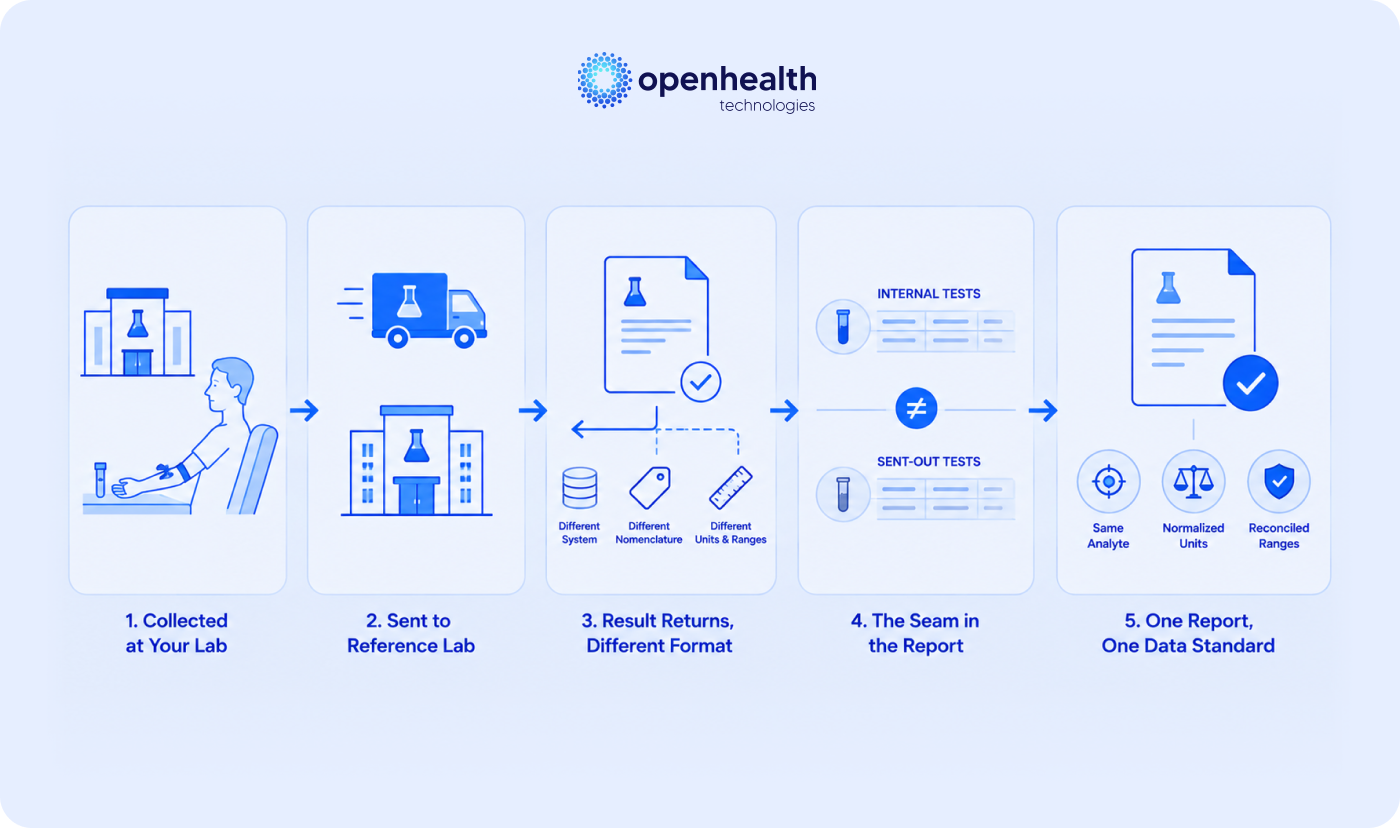
No laboratory does everything. Higher-complexity, lower-volume tests, or those requiring specific technology, are routinely sent to a reference laboratory, a specialized provider that performs the analysis and returns the result to the originating laboratory. This model is efficient and universal: it allows a laboratory to offer a broad test menu without maintaining internally the structure for all of them. The patient collects in one place, and the result, wherever it comes from, returns under the brand of the laboratory that served them.
The problem appears at the moment of return. The result that comes back from the reference laboratory was produced in a different system, with its own nomenclature, units, and reference ranges, and frequently doesn't fit cleanly into the originating laboratory's history. The test was performed with quality, the value is correct, but the way it returns creates a visible seam between what the laboratory does internally and what it sends out.
The seam invisible to the patient and visible in the data
For the patient and the requesting physician, the expectation is of a single, coherent report, regardless of which tests were done internally and which were sent to a reference laboratory. The originating laboratory takes responsibility for the result as if all of it had been produced in-house. In the data, however, the reality is different: the internal tests follow the originating laboratory's structuring, and the sent-out tests arrive with the reference laboratory's structuring, and the two don't always coincide.
This divergence manifests in several ways. The same analyte can come back from the reference laboratory with a nomenclature different from the one used internally. The units can differ, requiring conversion. The reference ranges can be different, because the reference laboratory uses its own methods and criteria. The result is that, in integrating the sent-out test into the patient's history, the originating laboratory faces the same incomparability that exists between distinct laboratories, only now within its own report.
Greenberg, in distinguishing standardization from harmonization, makes clear that results from different methods and origins only become clinically comparable through semantic harmonization, and not just through the transmission of the datum.¹ The test that comes back from the reference laboratory is an exemplary case: it was transmitted back, but not necessarily harmonized with the rest of the history where it will be inserted.
The cost of not integrating the sent-out test
When the sent-out test doesn't integrate in a harmonized way, the cost appears at several points. For the requesting physician, the comparison between a test the patient did before internally and the same test now sent out, or vice versa, is compromised if the nomenclature, units, or reference ranges changed along the way. The patient's trajectory, which should be continuous, gains a discontinuity that isn't clinical, it is a matter of data origin.
For the originating laboratory, the non-integration means that part of its own report escapes the structuring it applies to the rest. The laboratory invests in organizing its internal data and, in sending out a test, receives back a datum that doesn't follow that organization, creating an inconsistency within its own base. The higher the proportion of sent-out tests, the larger this non-integrated fraction, and the more the originating laboratory's base becomes a mosaic of different structurings.
The literature on health information exchange shows that receiving a datum from another source isn't the same as making it usable in an integrated way, and that real integration depends on semantic reconciliation.² The test that comes back from the reference laboratory illustrates this precisely: it arrived, but fitting it into the history in a comparable way requires work that mere transmission doesn't do.
Why the solution isn't bringing everything in-house
Faced with this problem, the intuitive reaction might be to reduce outsourcing, bringing more tests to internal execution. But that ignores the reason outsourcing exists: it is economically unfeasible for most laboratories to maintain internally the structure for all tests, especially high-complexity, low-volume ones. The reference laboratory is an efficient solution and will keep existing. The problem, therefore, isn't outsourcing itself, it is the non-harmonized integration of what returns from it.
The real solution isn't executing everything internally, it is making the test that comes back from the reference laboratory integrate into the originating laboratory's history in a harmonized way, regardless of where it was executed. This means recognizing that the sent-out analyte is the same analyte the originating laboratory knows, normalizing its units, reconciling its reference ranges, and inserting it into the history with the same structuring as the internal tests. The patient and the physician then receive a genuinely single report, not just in the brand's appearance, but in the comparability of the data.
Standards like LOINC for test identification exist precisely to allow the same analyte, executed in different systems, to be recognized as the same and compared reliably.³ Applied to the reference laboratory flow, they are what allows the originating laboratory to integrate the sent-out test as if it were internal, from the comparability standpoint.
The single report that is also single in the data
The change this scenario suggests is to make the originating laboratory's implicit promise, that of a single, coherent report, be fulfilled also at the data level, and not just at the brand level. When the test that comes back from the reference laboratory is harmonized and integrated, the seam between internal and sent-out disappears. The patient's history becomes continuous and comparable, regardless of which tests were executed where, and the originating laboratory delivers a report that is genuinely single.
This is a case in which the harmonization layer makes sense as infrastructure, because the challenge of reconciling each reference laboratory's structuring with the originating laboratory's is exactly the kind of semantic problem a specialized layer solves. The originating laboratory doesn't need to force each reference laboratory to adopt its nomenclature, which would be unfeasible; it needs a layer that recognizes and reconciles the differences at the moment the test returns.
This is where OpenHealth Technologies operates. The platform automatically correlates multiple data streams with rigorously validated logical layers of laboratory tests, recognizing that a sent-out test is the same analyte known internally, normalizing units, reconciling reference ranges, and integrating it into the originating laboratory's history in a comparable way, mapped to LOINC, across over 8,000 biomarkers. For laboratories that depend on reference laboratories, this means the test that comes back sent-out stops creating a seam in the history and starts fitting as if it had been executed internally, delivering to the patient and the physician a report that is single also in the data.
Learn how your institution can integrate the tests that return from the reference laboratory in a harmonized way, delivering a report that is single not just in the brand, but in the comparability of the data.