
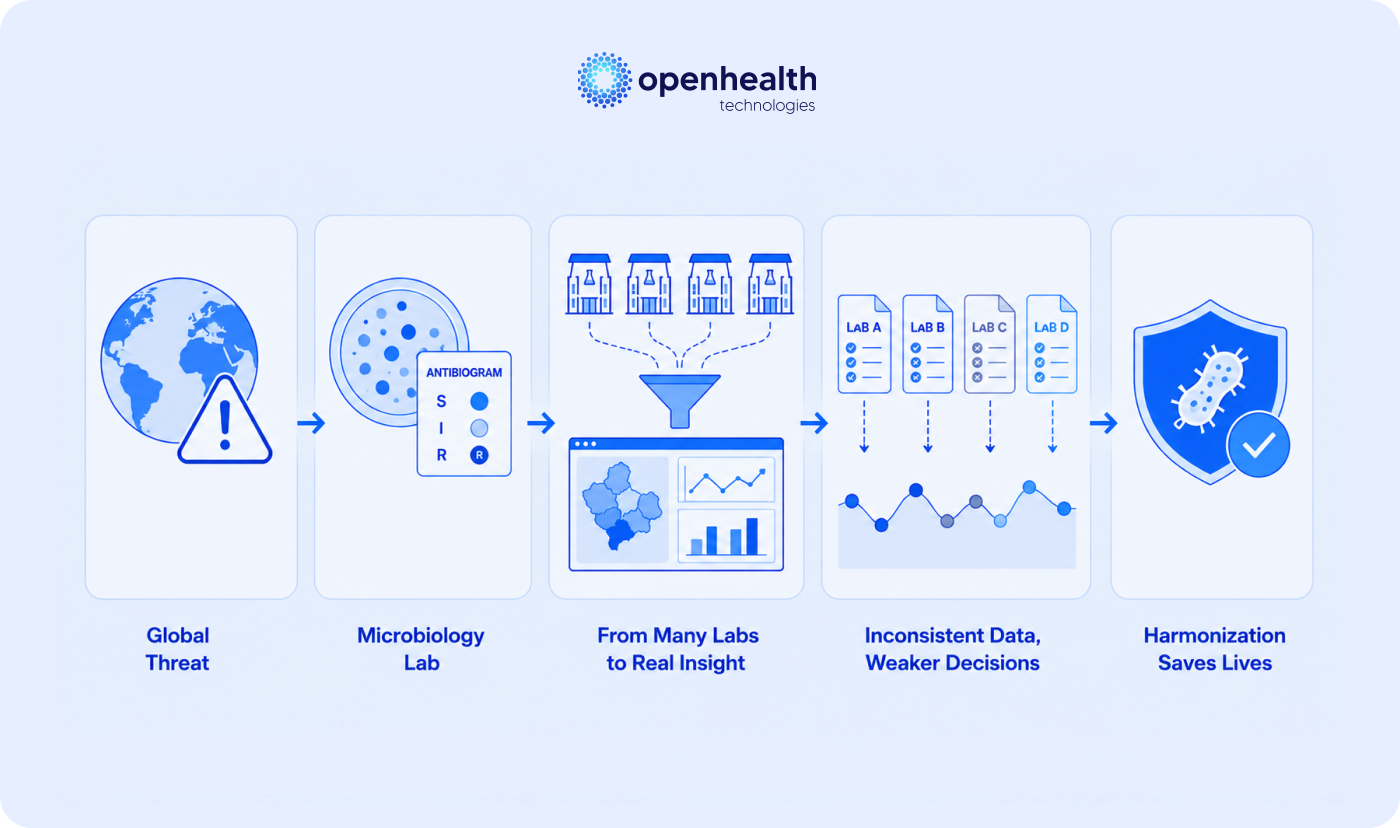
Antimicrobial resistance is recognized by the World Health Organization as one of the greatest threats to global public health, a problem that advances silently and that depends, to be confronted, on precise information: which microorganisms are circulating, which antimicrobials they resist, and how that pattern changes over time and territory. This information is born in a specific place: the microbiology laboratory, at the moment an antibiogram reveals a microorganism's susceptibility profile.
The problem is that this information, to serve surveillance and the rational use of antimicrobials, needs to be aggregated across many laboratories. And when each laboratory reports its microbiology results with different nomenclatures, criteria, and formats, the aggregation surveillance requires becomes slow, incomplete, and less reliable, precisely in the fight against a threat where precise and timely information is the main weapon.
Why resistance surveillance depends on comparable aggregation
Confronting antimicrobial resistance is, to a large extent, a population information problem. An isolated antibiogram guides one patient's treatment. Thousands of aggregated antibiograms reveal a region's resistance pattern, allow detecting the emergence of new resistance profiles, guide empirical treatment protocols, and sustain rational antimicrobial use programs. The difference between the individual result and the population pattern is aggregation, and aggregation is only useful when the data composing it is comparable.
This comparability is particularly demanding in microbiology. An antibiogram involves the identification of the microorganism, the panel of antimicrobials tested, the interpretation criteria for susceptibility and resistance, and the way all of this is reported. When different laboratories name microorganisms differently, test different panels, or report results in heterogeneous formats, the aggregation has to reconcile these differences before counting. Done manually, this reconciliation consumes time and introduces uncertainty, degrading the resolution of the epidemiological picture surveillance needs to see.
Bates and colleagues, in analyzing the use of large volumes of data in healthcare, highlight that the analytical value of clinical data depends on its structuring and its availability in a timely manner.¹ In antimicrobial resistance surveillance, this observation is literal: a resistance pattern that only emerges from aggregation depends on the microbiology data arriving structured and comparable, or the pattern arrives late and blurry.
The link between surveillance and stewardship
Resistance information doesn't only serve epidemiological surveillance in a broad sense. It is the basis of antimicrobial stewardship programs, the hospital and network initiatives that seek to ensure the rational use of these medications, preserving their efficacy and containing the advance of resistance. A stewardship program depends on knowing the local resistance profile to guide empirical therapy, the one started before the patient's individual result is ready, and to monitor whether the rational-use interventions are actually containing resistance.
This local profile is built by aggregating the institution's or network's antibiograms over time. If these antibiograms aren't comparable to each other, because they come from different laboratories with distinct criteria and nomenclatures, the resistance profile guiding stewardship is compromised. The program starts guiding empirical therapy based on a picture that mixes real resistance patterns with noise introduced by data heterogeneity, and the quality of rational-use decisions degrades at the source.
The literature on health information exchange shows that fragmentation between systems is a persistent obstacle to the flow of clinical data between organizations, and that overcoming it depends on semantic standardization, not just technical connectivity.² Applied to antimicrobial resistance, this means surveillance and stewardship depend on a layer that makes microbiology data comparable, and not just transmitted.
Comparability as containment infrastructure
The discussion about antimicrobial resistance usually focuses on new antibiotics, infection control, and rational-use campaigns. All of these elements are essential, but all depend on a frequently invisible layer: the ability to aggregate microbiology data in a comparable way. Without that layer, surveillance sees resistance with delay and low resolution, and stewardship guides decisions on a distorted picture. The comparability of microbiology data is, in this sense, resistance containment infrastructure.
Recognized standards for identifying laboratory tests and observations exist precisely to make data from different sources reliably aggregable.³ When laboratories structure their microbiology results mapped to those standards, aggregation for surveillance and stewardship stops requiring manual reconciliation and becomes possible in near real time, with the resolution the underlying data allows. Comparability, here, isn't a technical refinement. It is what separates a response to resistance that reacts to the past from one that tracks the present.
The Brazilian regulatory context reinforces the direction. The National Health Data Network and the structured laboratory result submission model, established by Ordinance GM No. 8,276 of the Ministry of Health in October 2025, establish the submission of results with recognized terminologies.⁴ The infrastructure laboratories build to comply with this model is the same one that makes antimicrobial resistance surveillance faster and more precise. Compliance and containment capacity converge on the same need for comparability.
The microbiology laboratory as a node in the response
Seeing the microbiology laboratory as a node in the response to antimicrobial resistance changes how its data is valued. A laboratory whose antibiograms are structured and comparable at the source contributes to surveillance and stewardship without introducing delay or loss of resolution. A laboratory whose microbiology data is heterogeneous is a node the network has to reconcile before using, and that reconciliation costs time and precision in a response that can't afford to lose either.
This contribution adds to the laboratory's clinical operation, it doesn't replace it. The same structuring that makes the antibiograms comparable for individual care makes them aggregable for surveillance and stewardship. The laboratory that builds this layer participates in resistance containment with the data it already produces.
This is where OpenHealth Technologies operates. The platform automatically correlates multiple data streams with rigorously validated logical layers of laboratory tests, structuring laboratory results from heterogeneous sources and mapping them to recognized standards like LOINC, in a comparable and aggregable way, across over 8,000 biomarkers. For the health ecosystem, this means the microbiology data born in the laboratory can feed antimicrobial resistance surveillance and stewardship programs with the speed and resolution containment requires, instead of arriving fragmented at the moment when precision is decisive.
Learn how your institution can transform microbiology results into comparable and aggregable data, able to sustain antimicrobial resistance surveillance and rational-use programs with the precision containment requires.