
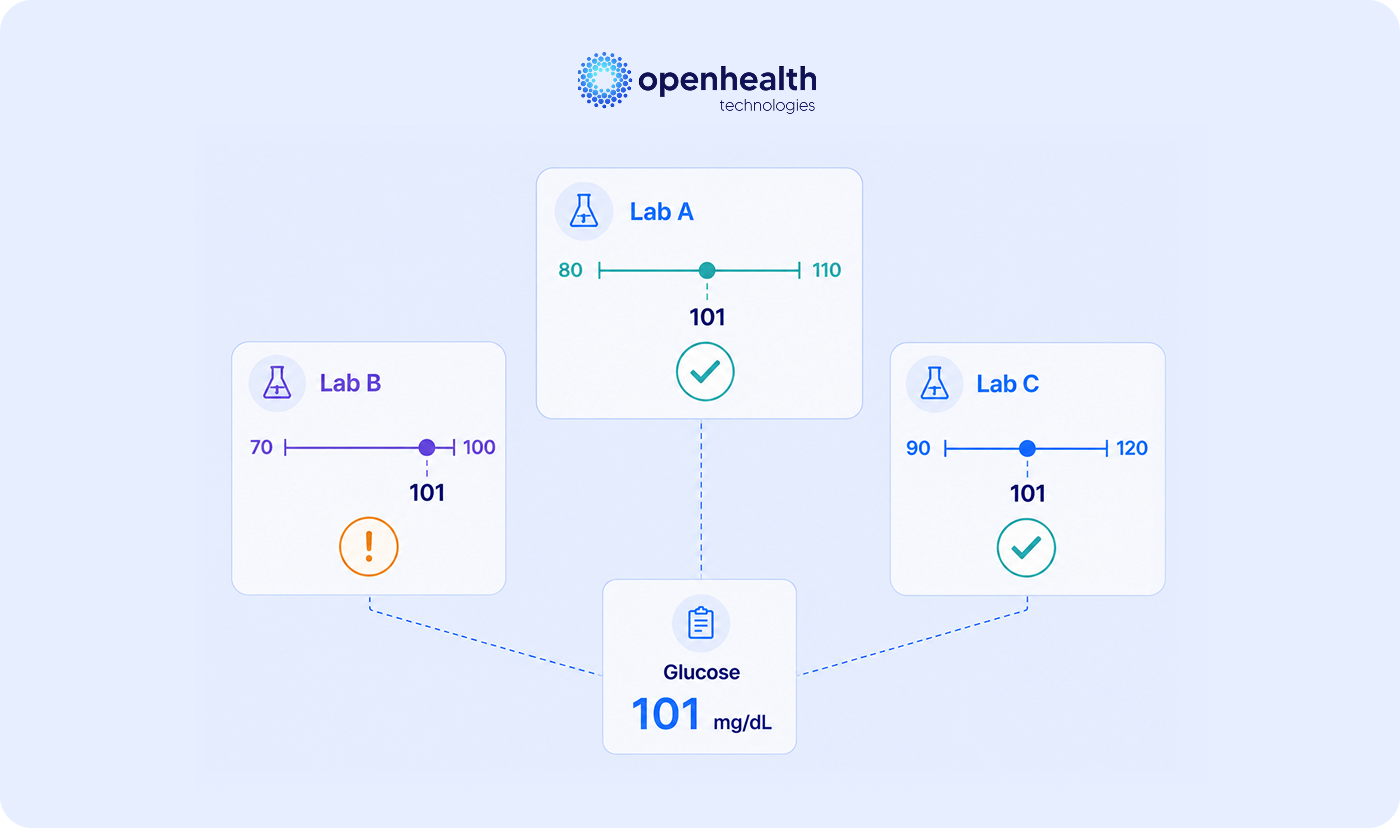
Every laboratory report carries, next to each result, a pair of numbers in parentheses: the reference interval, the one that separates "normal" from "abnormal." For the patient and, frequently, for the physician, these numbers look like a fixed truth of biology, as if there were a universal value beyond which a given biomarker becomes a cause for concern. There isn't. The reference range that appears on a report was defined by that laboratory, for that method, and it may be different from the range the neighboring laboratory prints for exactly the same test.
This variation is not a minor technical detail. It is one of the most silent and persistent sources of error in the diagnostic chain, and it operates at precisely the point where laboratory data becomes clinical decision.
What a reference range is, and why it varies
A reference interval is, in theory, the range of values observed in a healthy population for a given analyte. In practice, the way each laboratory establishes that interval varies enormously. Some laboratories conduct their own studies with their local population. Many adopt the ranges suggested by the reagent or equipment manufacturer. Others inherit intervals from old literature that has never been revised. And because different laboratories use different analytical methods, equipment, and reference populations, the same analyte ends up with "normality" ranges that don't coincide across institutions.
The literature documents this problem directly. Katayev and colleagues, in a reference study on the topic, demonstrate that the methods used to establish reference intervals are frequently inconsistent between laboratories, and that this inconsistency has a measurable effect on result classification.¹ What is a within-range result for one laboratory may be a result flagged as abnormal for another, without anything having changed in the patient's physiology.
The consequence is that the reference range, which should be the instrument that gives clinical meaning to the number, becomes itself a source of ambiguity. The absolute value is only half the information. The other half is the range against which it is compared, and that half changes with the laboratory.
The error that appears in comparison between laboratories
The problem manifests most strongly when a patient has tests done at different laboratories over time, which is the rule and not the exception. Consider a biomarker tracked over a year. The first test, done at laboratory A, returns a value classified as normal according to that laboratory's range. The second test, done at laboratory B, returns a numerically close value, but classified as abnormal according to laboratory B's narrower range.
For the physician comparing the two reports, the immediate reading is that something changed in the patient: a result that was normal became abnormal. But what changed wasn't the patient. It was the reference range. The real clinical trajectory may have remained perfectly stable, and the appearance of deterioration is an artifact of the difference between the intervals used by the two laboratories.
The error also occurs in the opposite direction, and that is the more dangerous one. A real deterioration in the patient can be masked when the second laboratory uses a wider range that absorbs the new value within "normality." The physician receives two results, both marked normal, and concludes everything is stable, when in fact there was a worsening that the range difference hid. Katayev and colleagues show that these classification discrepancies between laboratories can reach relevant proportions for certain tests, which means the problem is neither rare nor marginal.¹
Why standardizing nomenclature doesn't solve it
There is a temptation to treat this problem as if it were the same thing as nomenclature standardization, and to imagine that solving it is just a matter of all laboratories calling the test by the same name and using the same unit. Standardizing nomenclature and unit is necessary, but not sufficient. Two laboratories can use exactly the same test name, exactly the same unit, and still apply different reference ranges, producing divergent classifications for the same value.
This is where the distinction between standardization and harmonization becomes concrete. Standardization aligns the form: name, unit, format. Harmonization aligns the clinical meaning: it ensures a value produced in one context is clinically equivalent and comparable to a value produced in another. Greenberg, in a central review on the concepts of standardization, traceability, and harmonization in laboratory medicine, is explicit about this difference, and about the fact that real comparability between results depends on harmonization, not just formal standardization.²
In the case of reference ranges, this means the solution is not just recording which range each laboratory used, although that record is a prerequisite. It is making that information structured and explicit, so that the classification of a result can be done consistently, with the applicable range identified, documented, and comparable across sources. Without that, any longitudinal analysis that depends on the normal/abnormal classification is built on a base that changes from laboratory to laboratory.
The impact that propagates beyond individual reading
Reference range variation doesn't affect only the reading of an individual report. It contaminates everything built on top of result classification. Clinical decision-support systems that fire alerts when a value is out of range depend on the correct range to avoid generating false positives and false negatives. Chronic care management programs that stratify patients by control of a biomarker depend on consistent ranges to avoid classifying the same patient differently depending on the provider. Predictive models trained on data labeled as normal or abnormal learn, along with the clinical signal, the noise introduced by range variation between the data sources.
The international quality standard for clinical laboratories, ISO 15189, treats metrological traceability and the definition of reference intervals as central components of laboratory quality, precisely because it recognizes that result comparability depends on them.³ A result is only clinically interpretable when the range against which it is compared is known, documented, and traceable. When each laboratory keeps its own ranges in an isolated and unstructured way, that traceability is lost the moment data from different sources needs to be brought together.
The REL model of the National Health Data Network, established by Ordinance GM No. 8,276 of the Ministry of Health in October 2025, requires structured submission of laboratory results with recognized terminologies.⁴ Structuring the reference interval is one of the points where that submission most depends on prior organization of the data, precisely because ranges vary between laboratories and need to be explicitly recorded for the submitted data to be interpretable at its destination.
The reference range as structured data, not text in the footer
Correcting the problem doesn't go through forcing all laboratories to adopt identical ranges, which would be clinically inadequate, since ranges legitimately vary by method, age, sex, and population. It goes through treating the reference range as structured data that accompanies each result, explicitly recorded and comparable, rather than loose text in the report footer that is lost the first time the data is extracted.
When each result carries, in structured form, the method that produced it, the unit in which it is expressed, and the applicable reference range, with its origin documented, the normal/abnormal classification stops being a trap in comparison between laboratories. The patient's trajectory can be read with the correct range applied to each point, and the appearance of change that is actually a range artifact disappears. It is this level of semantic structuring that separates a laboratory history that misleads from one that informs.
This is where OpenHealth Technologies operates. The platform automatically correlates multiple data streams with rigorously validated logical layers of laboratory tests, identifying for each laboratory result its methodology, its unit, and its applicable reference range, in structured form and comparable across sources. For laboratories and for those who consume their data, this means the classification of a result stops depending on which range each laboratory printed in isolation in the footer, and the longitudinal reading comes to distinguish real patient change from range variation between institutions.
Learn how your institution can transform dispersed and inconsistent reference ranges into structured, comparable data, the foundation of a clinical reading that doesn't confuse laboratory variation with patient change.