
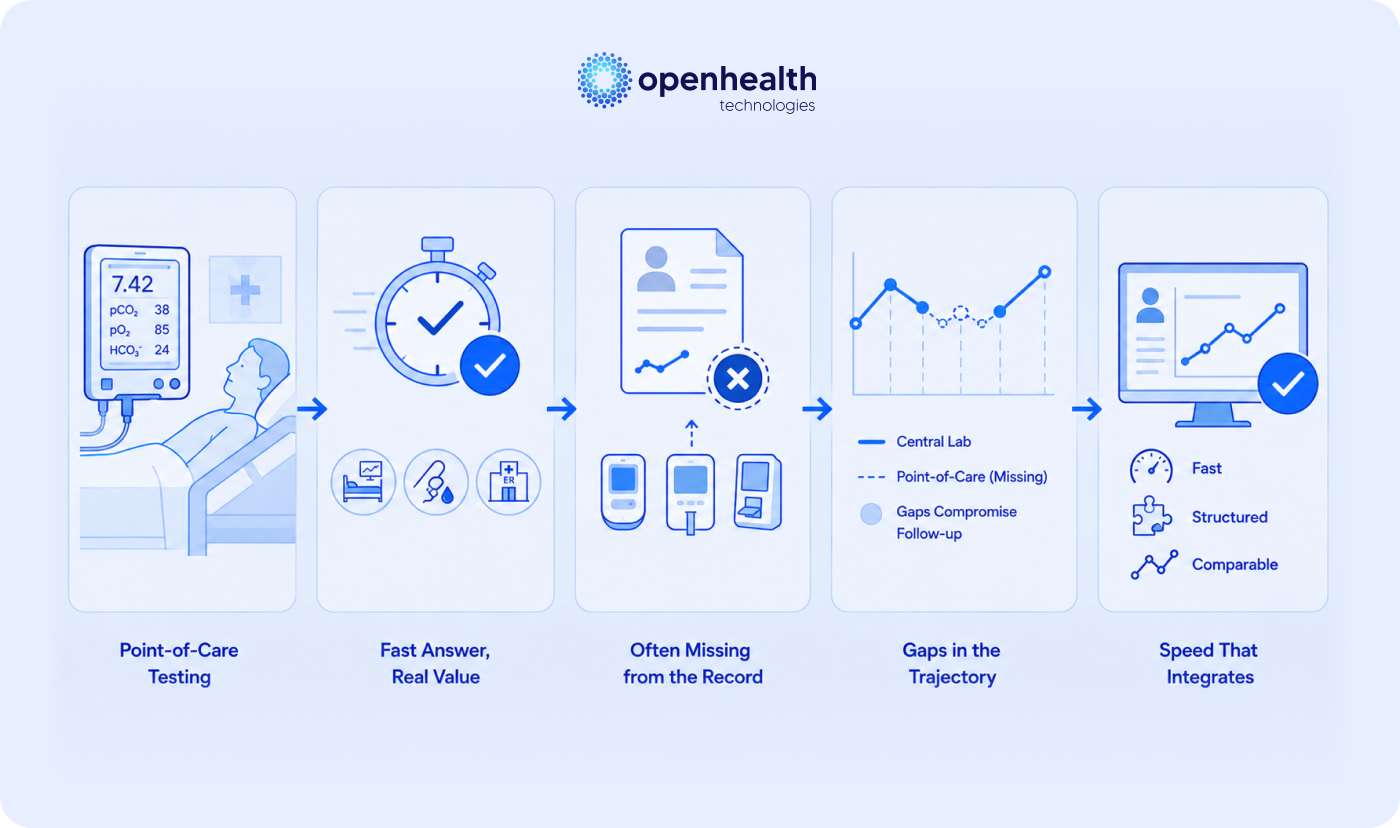
Point-of-care testing, performed at the bedside rather than in the central laboratory, has become an essential part of hospital medicine. A blood gas done in the intensive care unit itself, a capillary glucose measured at the bedside, a rapid test in the emergency room: all deliver an answer to the professional in minutes, without the wait of sending it to the central laboratory. This speed saves time in situations where time is critical, and that is why point-of-care testing has expanded across hospitals and urgent care services.
There is, however, a structural problem in this expansion that rarely receives attention proportional to its severity: many of these results never reach the patient's record in structured form. The value was measured, was used in the immediate decision, and then was lost, or was recorded in a way that doesn't integrate into the patient's history nor compare to the central laboratory's tests.
The time gain that creates a data gap
The proposition of bedside testing is to deliver the result where and when it is needed, without the latency of the traditional laboratory flow. This gain is real and clinically valuable. But it was designed to solve the speed problem, not the integration one, and that is where a gap opens.
In the central laboratory flow, the result is born inside a system that structures it, identifies it, and records it in the patient's history. In bedside testing, the result frequently is born in an isolated device, whose output is a screen, a piece of paper, or, at best, a record that doesn't follow the same structuring as the central laboratory. The professional reads the value, makes the decision, and the datum fulfills its immediate function. What frequently doesn't happen is this datum entering the record in a structured and comparable way.
The result is a systematic gap in the patient's history. Tests that were done, whose values existed and guided decisions, simply don't appear in the longitudinal record, or appear in a way that doesn't integrate with the rest. The literature on quality indicators in laboratory medicine recognizes that the value of a test depends on its incorporation into the record and the clinical decision, and that data that doesn't arrive in a usable form has its value compromised.¹ Bedside testing, when it doesn't integrate, produces exactly this waste: data that existed and didn't persist.
Why the gap matters more than it seems
At first glance, a bedside test result that has already fulfilled its immediate function may seem disposable. If the blood gas guided the ventilator adjustment at that moment, what's the problem with it not entering the structured history? The problem is that follow-up medicine depends on the trajectory, and each absent result is a hole in that trajectory.
Consider a critical patient whose function is monitored by successive measurements over hours or days. If part of these measurements was done at the bedside and didn't enter the structured history, the curve the physician sees has gaps, or mixes structured values from the central laboratory with bedside values that aren't directly comparable because they come from different methods and devices. The trajectory, which is what guides the case's management, is incomplete or distorted, not for lack of measurement, but for lack of integration and comparability of the measurements made.
This is aggravated because bedside testing devices and central laboratory analyzers may use different methods, producing values that require care in comparison. A bedside result and a central laboratory result for the same analyte aren't necessarily interchangeable, and treating them as if they were, or not being able to compare them in an informed way, introduces noise into the longitudinal reading. Comparability, here, isn't automatic: it depends on the results being structured so that their origin, their method, and their unit are known.
Integration as part of the value of bedside testing
The implication is that the full value of bedside testing doesn't materialize only in the speed of the immediate response. It materializes when that fast response also integrates into the patient's history in a structured and comparable way, adding to the trajectory instead of being lost after the point use. A bedside test that delivers speed but doesn't integrate resolves half the problem and leaves the other half, continuity, without a solution.
Resolving the integration requires a layer that receives the results from the bedside devices, structures them, identifies their method and their unit, and incorporates them into the patient's history in a way comparable to the central laboratory's results. Shortliffe and Cimino, in a central reference of biomedical informatics, argue that data quality and structuring are the foundation on which any subsequent clinical use is built, and that unstructured data compromises that foundation at the source.² For bedside testing, this means the structuring of the result is what transforms a point-in-time response into part of a history.
Standards like LOINC for test identification exist precisely to allow results from different sources and devices to be identified in a common way and compared reliably.³ Applied to bedside testing, they are what allows a result generated on an isolated device to be recognized, structured, and integrated into the history as a full-fledged datum, and not as a loose number that gets lost.
From point value to longitudinal value
The change this scenario suggests is to stop treating the bedside result as disposable data after immediate use, and start treating it as part of the patient's history from the origin. When each bedside result is structured, identified, and integrated, the gap in the history closes. The patient's trajectory comes to contain all measurements made, from the central laboratory and from the bedside, in a comparable way, and the longitudinal reading no longer has holes.
This closing has a direct effect on the safety and quality of care. The physician following the patient's evolution comes to see the complete curve. The history that follows the patient to other points of care comes to contain the bedside results too. And the value these tests already generate in the immediate response extends to the follow-up, instead of being exhausted in the instant of use.
This is where OpenHealth Technologies operates. The platform automatically correlates multiple data streams with rigorously validated logical layers of laboratory tests, receiving results from different sources and devices, including those generated at the bedside, and integrating them into the patient's history in a structured, identified, and comparable way, mapped to LOINC, across over 8,000 biomarkers. For hospitals and urgent care services, this means the bedside result stops being lost after immediate use and starts adding to the patient's trajectory, closing the gap that point-of-care testing fragmentation usually opens.
Learn how your institution can ensure bedside results integrate into the patient's history in a structured and comparable way, instead of being lost after immediate use.