
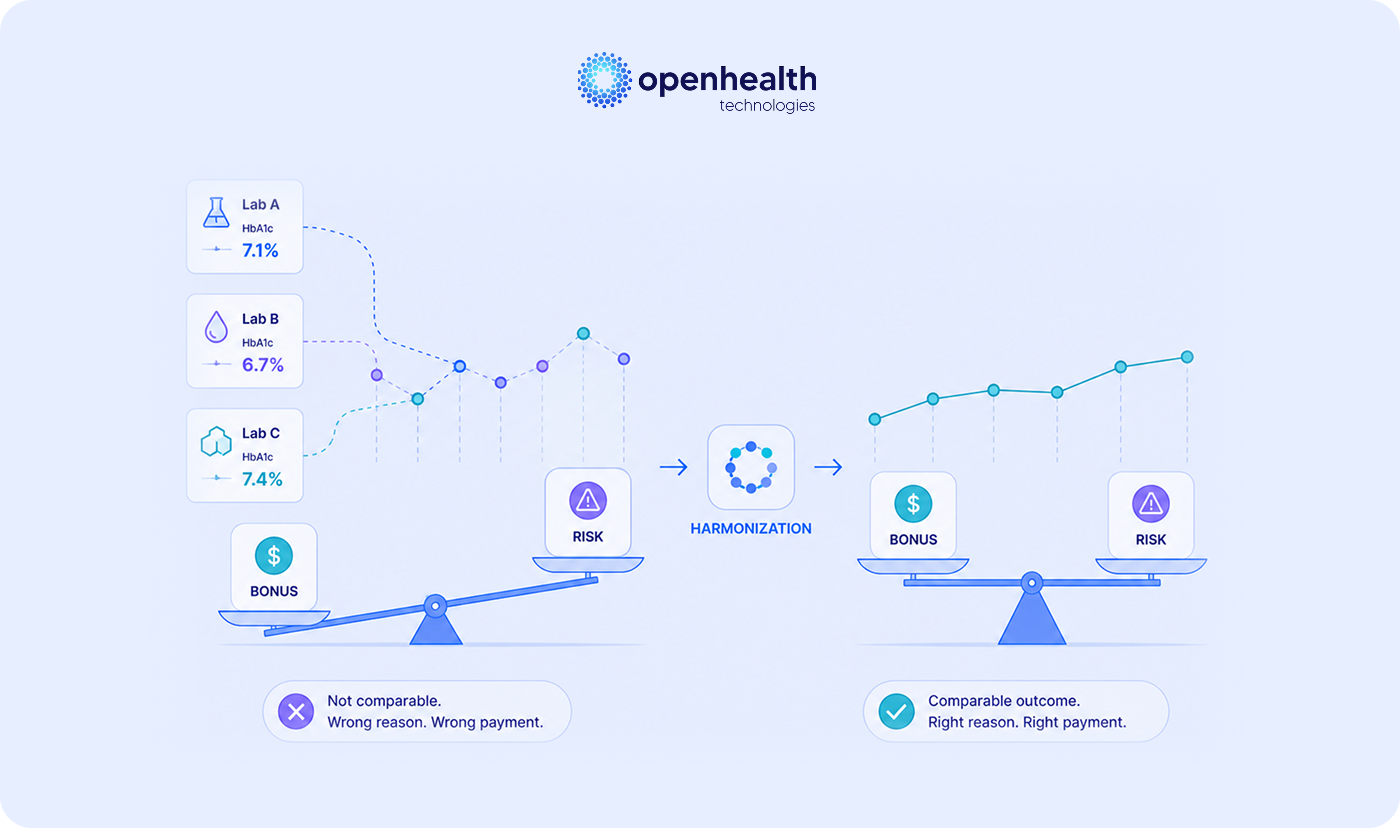
Value-based care is presented as the correction of a structural defect in the health system: payment by volume, which rewards the quantity of procedures regardless of the result they produce. In its place, value-based care models propose paying for the outcome: the provider earns more when the patient improves, and takes on risk when they don't. The logic is sound and the direction is correct. But there is an assumption at the center of these models that rarely receives the scrutiny it deserves: the ability to measure outcomes reliably.
Health outcomes, in a huge share of cases, are biomarkers over time. And biomarkers over time, when they come from different providers without harmonization, are not a reliable measure. This is where the value-based care equation rests on an unstable base that no one put in the contract.
What exactly these contracts measure
A value-based payment contract needs to define, in operational terms, what counts as a good outcome. For a diabetic population, the outcome is typically glycemic control, measured by glycated hemoglobin. For a population with cardiovascular risk, it is the lipid panel and blood pressure. For chronic kidney disease, it is the estimated glomerular filtration rate and creatinine. In all these cases, the indicator that defines whether the provider met the target, and therefore whether they receive a bonus or take a loss, is a laboratory biomarker tracked over time.
For that indicator to be fair as a basis for payment, it needs to measure the same thing for every patient in the contracted population. When the tests come from different providers, with distinct methodologies, units, and reference ranges, that condition isn't met. Two patients with the same real control can appear with numerically different biomarkers just because they were measured at different laboratories. Glycated hemoglobin, for example, can be reported in distinct unit systems that produce different numbers for the same physiological reality, an issue the literature documents in detail.¹
The contract measures outcome. But what it effectively captures is outcome contaminated by methodological variation, and the account that separates bonus from penalty is calculated over that mix.
Why variation becomes money in the value model
In volume payment, the incomparability of laboratory data is a clinical and operational problem. In value payment, it becomes also a direct financial problem, because data variation converts into payment variation.
Consider a cohort whose contractual target is to reduce the average glycated hemoglobin over a period. If, between the initial and final measurement, the composition of the providers that performed the tests changes, with different proportions of methodologies, the cohort's average can move for reasons that have nothing to do with the patients' real glycemic control. The provider may receive a bonus for an improvement that is an artifact of a change in the data source, or may be penalized for a worsening that is also an artifact. In both cases, money changes hands based on a measurement that doesn't reflect the outcome the contract intended to pay for.
This risk is asymmetric and silent. Asymmetric because both the payer and the provider can be harmed, depending on the direction of the variation, and neither has visibility into it. Silent because the final number, the cohort average, is mathematically correct and looks reliable. The problem isn't in the calculation. It is in the comparability of the data entering the calculation, and that comparability doesn't appear in any report.
The value model is more demanding of data, not less
There is an implicit expectation that moving from volume to value resolves data problems. In practice, the value model is far more demanding of data quality than the volume model. In volume payment, it is enough to record that a procedure was done. In value payment, it is necessary to measure, compare, and attribute outcomes over time and across providers, which requires a level of data comparability the volume model never demanded.
Porter and Lee, in one of the most influential formulations of health value strategy, argue that measuring outcomes rigorously is the fundamental condition for value-based payment to work, and that most organizations drastically underestimate the difficulty of that measurement.² The difficulty isn't only in deciding what to measure. It is in ensuring the measurement is comparable across sources, over time, for the whole population. Without that, the measured outcome doesn't bear the financial weight the contract places on it.
Porter and Teisberg, in the work that founded much of the thinking on value-based competition, already pointed out that outcome information needs to be standardized and comparable for value-based competition to be possible.³ Two decades later, the data infrastructure that would make that comparability real is still the exception, not the rule, and value contracts are signed as if it already existed.
Harmonization as a contractual precondition
The practical implication is direct: harmonization of laboratory data is not a technical detail to be resolved after the value contract is working. It is a precondition for the contract to measure what it claims to measure. A value-based payment contract built on non-harmonized biomarkers is distributing bonus and risk based on a measurement whose relationship to the real outcome is unknown.
The correction goes through ensuring that each biomarker entering the contract's account is semantically identified and comparable: with known methodology, normalized unit, and documented reference range, so that one patient's outcome is genuinely comparable to another's and to their own over time. Greenberg is explicit in distinguishing standardization from harmonization, and in showing that real clinical comparability, the kind an outcome account requires, depends on semantic harmonization, not just format alignment.⁴ Standards like LOINC provide the common identity on which that comparability is built.⁵
When the data is harmonized, the value-based payment account starts measuring real outcomes, and not outcomes mixed with methodological noise. The bonus rewards true improvement. The risk reflects true worsening. And the value model fulfills the promise that justifies it: aligning payment with clinical result.
This is where OpenHealth Technologies operates. The platform automatically correlates multiple data streams with rigorously validated logical layers of laboratory tests, identifying for each biomarker its methodology, its unit, and its reference range, and delivering to insurers and providers a base in which outcomes from different sources are genuinely comparable, across over 3,500 biomarkers. For value-based payment contracts, this means the outcome measurement that defines bonus and risk stops operating over incomparable data and starts reflecting the real clinical result of the contracted population.
Learn how your insurer can ensure the value-based payment account measures real clinical outcomes, and not methodological variation between providers.