
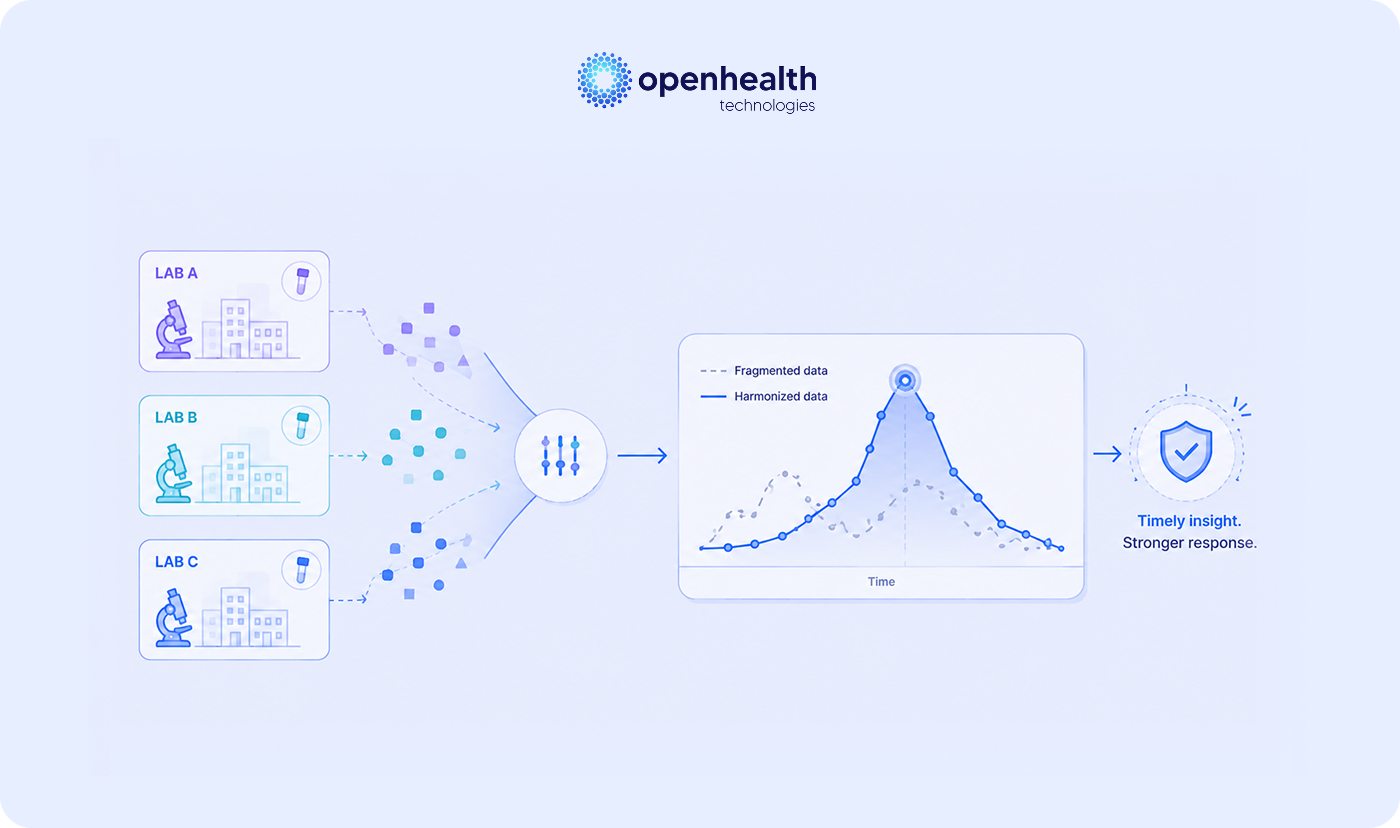
When an arbovirus advances in a Brazilian city, or when a flu-like syndrome starts filling emergency rooms, the public health response depends on information that needs to arrive fast: how many cases, where, at what growth rate. Much of this information is born in the laboratory, at the moment a test confirms a diagnosis. The laboratory is, in this sense, the front line of epidemiological surveillance, the point where the data public health needs is generated before anywhere else.
The problem is that this data, to be useful to surveillance, needs to be aggregated with that of thousands of other laboratories in a timely manner. And when each laboratory reports its results in different nomenclatures and formats, the aggregation surveillance requires slows down and loses resolution, precisely at the moment when speed and precision are everything.
Why surveillance depends on fast aggregation
Epidemiological surveillance works through patterns that only emerge at the population scale. An isolated case of dengue is a diagnosis. Thousands of cases of dengue, mapped by region and by time, are an outbreak with a growth curve that allows anticipating hospital demand, directing campaigns, and allocating resources. The difference between the isolated case and the population pattern is aggregation, and the usefulness of aggregation depends on two things: speed and comparability.
Speed because surveillance operates against time. Outbreak data that arrives two weeks late describes a past the response can no longer alter. Comparability because aggregating data from different sources only makes sense if that data means the same thing. When one laboratory reports a result with one nomenclature and another reports the same finding with a different nomenclature, the aggregation has to reconcile those differences before counting, and that reconciliation, when done manually, consumes exactly the time surveillance doesn't have.
Bates and colleagues, in analyzing the use of large volumes of data in healthcare, highlight that the analytical value of clinical data depends on its structuring and its availability in a timely manner, and that unstructured data compromises the ability to generate insight when it matters. In epidemiological surveillance, this observation is literal: data that can't be aggregated fast doesn't serve the response.
What fragmentation costs the public health response
Fragmentation of laboratory data has, in surveillance, a cost that isn't only about efficiency, it is about response capacity. When results arrive in heterogeneous formats, epidemiological aggregation faces two simultaneous problems: delay and loss of resolution.
The delay comes from the reconciliation work. Each different nomenclature, each distinct format, each unit that needs conversion adds a step between the result existing in the laboratory and the result entering the epidemiological count. In an outbreak situation, where the volume of tests spikes, this reconciliation work scales along with it, and the surveillance system gets slower exactly when it would need to be faster.
The loss of resolution comes from uncertainty. When aggregation has to reconcile heterogeneous data, part of the results ends up not being classified with confidence, or is grouped coarsely to work around the ambiguity. The resulting epidemiological curve is less precise than the underlying data would allow, because fragmentation forced a simplification. Surveillance sees the outbreak, but with less sharpness than the available information should provide.
Adler-Milstein and colleagues, in studying information exchange between health institutions, document that fragmentation and low interoperability between systems are persistent obstacles to the flow of clinical data between organizations, and that overcoming them depends on semantic standardization, not just technical connectivity. Epidemiological surveillance is one of the uses in which this obstacle has the most direct consequence for the population.
Harmonization as public health infrastructure
The discussion about harmonization of laboratory data is usually framed in terms of private operation: laboratory efficiency, quality of care, competitive advantage. Epidemiological surveillance shows that harmonization is also public health infrastructure. A health system's ability to respond fast to an outbreak depends, in part, on the laboratory data feeding surveillance being comparable at the source.
Standards like LOINC for identifying laboratory tests and observations exist precisely to make data from different sources reliably aggregable. When laboratories structure their results mapped to those standards, epidemiological aggregation stops requiring manual reconciliation and becomes possible in near real time, with the resolution the underlying data allows. Harmonization, in this context, is not an operational refinement. It is what separates a surveillance that reacts to the past from one that tracks the present.
The Brazilian regulatory context moves in this direction. The National Health Data Network and the laboratory test result information model, established by Ordinance GM No. 8,276 of the Ministry of Health in October 2025, establish the structured submission of laboratory results with recognized terminologies. The infrastructure laboratories build to comply with this model is the same one that makes epidemiological surveillance faster and more precise. Regulatory compliance and public health response capacity converge on the same need for harmonization.
The laboratory as a node in a response network
Seeing the laboratory as the front line of surveillance changes how its data is valued. A laboratory whose results are structured and comparable at the source isn't just more efficient in its own operation, it is a functional node of a public health response network, able to contribute to epidemiological aggregation without introducing delay or loss of resolution. A laboratory whose data is fragmented is a node the network has to reconcile before using, and that reconciliation costs the time the response doesn't have.
This contribution doesn't replace the laboratory's clinical and commercial operation, it adds to it. The same data structuring that makes the laboratory's results comparable for individual care and for management makes them aggregable for surveillance. The laboratory that builds this layer participates in the public health response with the data it already produces, without additional effort at each outbreak.
This is where OpenHealth Technologies operates. The platform automatically correlates multiple data streams with rigorously validated logical layers of laboratory tests, structuring laboratory results from heterogeneous sources and mapping them to LOINC, in a comparable and aggregable way, across over 3,500 biomarkers. For the health ecosystem, this means the data born in the laboratory can feed epidemiological surveillance in a timely manner and with the resolution the response requires, instead of arriving fragmented and delayed at the moment when speed is decisive.
Learn how your institution can transform laboratory results into comparable and aggregable data, able to feed epidemiological surveillance with the speed and resolution the public health response requires.