
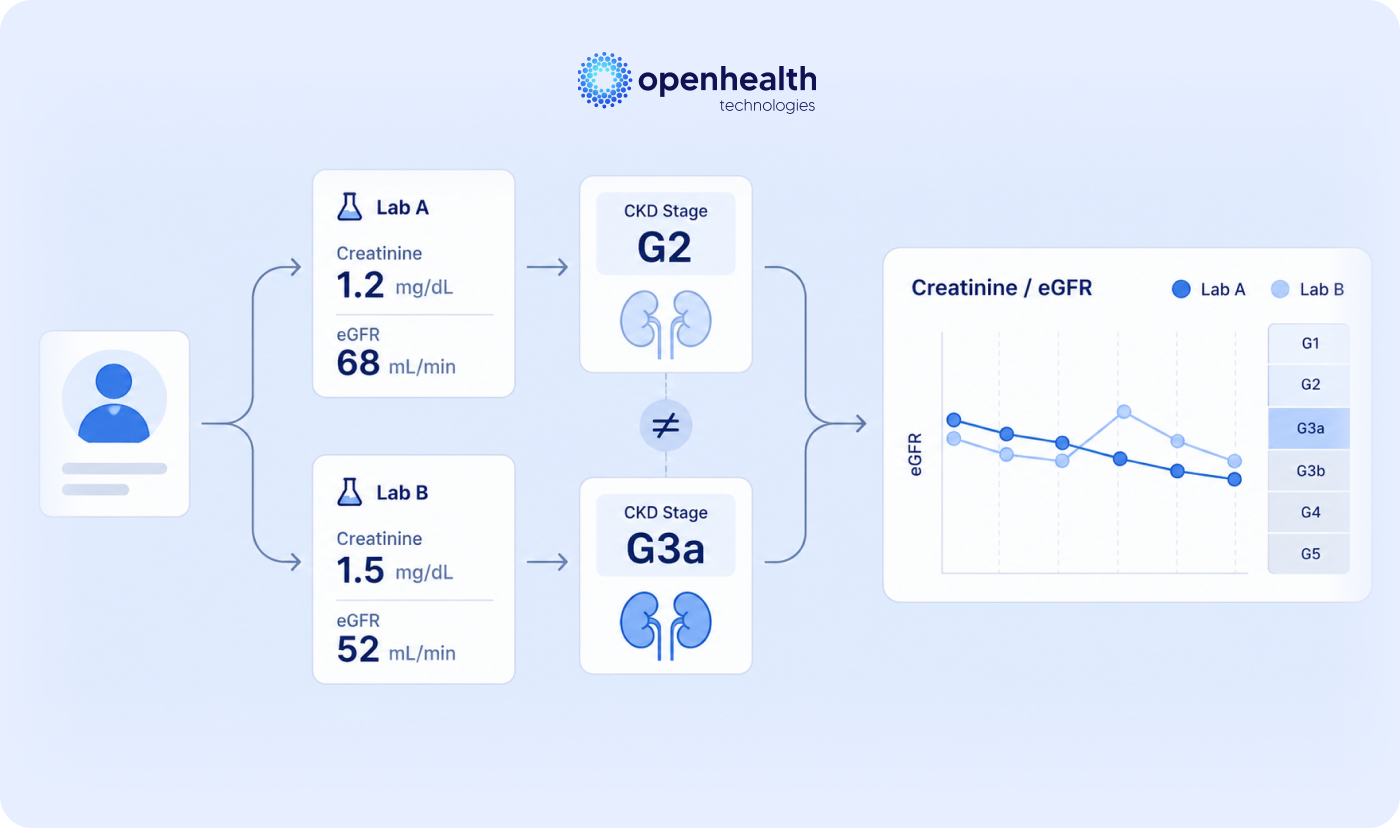
Chronic kidney disease is classified into stages, and this staging isn't an academic detail: it guides practically everything in the patient's management. The stage determines the frequency of follow-up, the moment to refer to the nephrologist, medication adjustments, preparation for renal replacement therapy, and the communication of risk to the patient. And the stage is defined, to a large extent, by a number: the estimated glomerular filtration rate, calculated from creatinine.
The problem is that creatinine, and consequently the estimated glomerular filtration rate, can vary depending on the laboratory that measured it. Different analytical methods, different calibrations, and different reference ranges produce values that aren't perfectly interchangeable. When the patient has tests at different laboratories over the course of follow-up, the stage of their kidney disease can appear to change not because renal function changed, but because the laboratory changed. And a staging that oscillates for methodological reasons guides clinical decisions on an unstable base.
Why the stage depends on comparability
The staging of chronic kidney disease works by ranges: each interval of the estimated glomerular filtration rate corresponds to a stage, with its own clinical implications. A patient whose rate drops from one range to another is reclassified, and that reclassification triggers changes in conduct. That is why the precision of the value that defines the stage matters greatly, and the comparability of that value over time matters even more, because the management of chronic kidney disease is fundamentally longitudinal: what matters isn't just today's value, but the trajectory.
This dependence on the trajectory makes staging vulnerable to variation between laboratories. If a patient's creatinine was measured at one laboratory at the start of follow-up and at another laboratory months later, with different methods or calibrations, the comparison between the two values can suggest a change in renal function that is, in fact, an artifact of the difference between the laboratories. The trajectory the nephrologist reads, and on which they decide, then contains a variation that isn't physiological.
Katayev and colleagues document that reference intervals and methods vary between laboratories, and that this variation has a measurable effect on result classification.¹ Applied to creatinine and the estimated glomerular filtration rate, this means the boundary between one stage and another can be crossed, in appearance, because of a change of laboratory, and not a real clinical change.
The two directions of the error
Staging distorted by variation between laboratories can err in two directions, both with consequences.
In the first, the stage appears to worsen without renal function having worsened. A value measured at a laboratory with a different method suggests a lower filtration rate, the patient is reclassified to a more advanced stage, and this can trigger referrals, medication changes, and risk communication that don't correspond to the real situation. The patient and the system bear an intensification of conduct that physiology didn't justify.
In the second, more dangerous one, a real worsening is masked. If the laboratory that measured the most recent value tends to produce higher filtration rates than the previous one, a true deterioration of renal function can be absorbed and not appear as a change in stage. The nephrologist reads an apparently stable trajectory, and the disease progression that would require intensified care goes unnoticed until it manifests in a more advanced form.
In both cases, the problem isn't in the nephrologist's clinical judgment, which correctly interprets the data it receives. It is in the comparability of the data that arrives. A staging built on values that aren't comparable to each other is a staging that can mislead even when each isolated value is technically correct.
Why standardizing the test isn't enough
It might seem the problem is solved by ensuring all laboratories use the same method for creatinine. Method standardization is desirable and there are international efforts in that direction, but it isn't universally achieved, and the nephrologist doesn't control where the patient had each test over the years. The patient brings a history done at multiple laboratories, and that history already exists with the heterogeneity it has.
That is why the comparability of staging can't depend only on waiting for all laboratories to standardize. It needs a layer that recognizes, for each creatinine value in the patient's history, the method and unit that produced it, and that allows reading the trajectory in an informed way, distinguishing methodological variation from physiological change. Greenberg is explicit in showing that real clinical comparability depends on semantic harmonization, and not just format standardization.² For renal staging, this harmonization is what transforms a set of values from different origins into a reliable trajectory.
Standards like LOINC for test identification provide the basis for recognizing that creatinine values from different laboratories refer to the same analyte and can be organized into a comparable series, with their origin documented.³ This identification is what allows the estimated glomerular filtration rate to be read over time without the change of laboratory being confused with disease progression.
The reliable staging as the basis of management
The change this scenario suggests is ensuring that chronic kidney disease staging relies on a genuinely comparable creatinine trajectory, and not on a sequence of values from different origins treated as if they were interchangeable. When each value is identified with its method and its unit, and the trajectory is read in a harmonized way, the stage comes to reflect the patient's real renal function, and not the variation between the laboratories that measured it.
This reliable staging has a direct effect on management. The referral to the nephrologist happens at the right moment, guided by a real progression. Medication adjustments respond to the true renal function. Preparation for renal replacement therapy is based on a trajectory that describes the patient, not the mosaic of laboratories they passed through. And the communication of risk to the patient reflects their actual situation.
This is where OpenHealth Technologies operates. The platform automatically correlates multiple data streams with rigorously validated logical layers of laboratory tests, identifying for each creatinine value its method, its unit, and its reference range, and organizing the trajectory in a comparable way over time, mapped to LOINC, across over 8,000 biomarkers. For clinics and nephrology services, this means chronic kidney disease staging comes to rely on a trajectory that reflects the patient's real renal function, and not the methodological variation between the laboratories that produced the tests.