
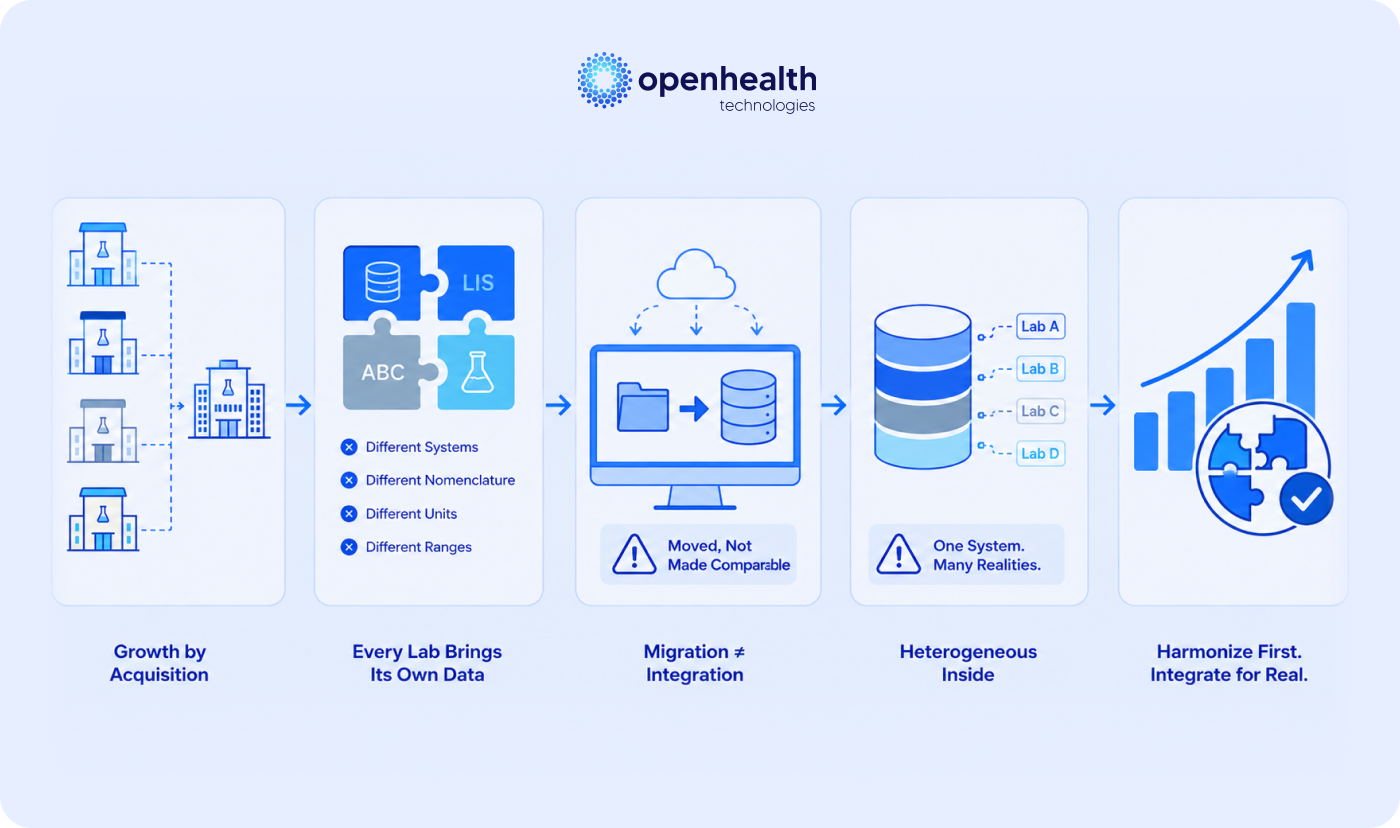
Brazil's diagnostic medicine sector has gone through, over the past decade, an intense consolidation movement. Large groups grew by acquiring smaller laboratories, regional networks were incorporated into national operations, and the result is a market where many of the largest institutions are, in practice, the sum of dozens of laboratories that were once independent. Each acquisition is celebrated for what it adds: installed capacity, geographic presence, client base, revenue.
What rarely enters the calculation, and almost always charges its price later, is what each acquisition also adds in data complexity. Every acquired laboratory arrives with its own information system, its own test nomenclature, its own units and reference ranges. The merger unites the operations on the org chart long before it unites the data, and it is in that lag that a problem lives that compromises much of the value the consolidation promised to generate.
What consolidation really joins
A laboratory merger or acquisition is presented, at the strategic level, as the union of two operations. At the data level, it is the forced coexistence of two or more semantic universes that were never designed to talk to each other. The acquiring laboratory has its way of naming, measuring, and reporting each test. The acquired one has its own. When the two operations start operating under the same brand, the client and the physician start expecting consistency, but the data behind them keeps speaking different languages.
This incompatibility isn't an IT detail to be resolved later. It touches the core of the consolidation's value proposition. The promise of a consolidated network is that the patient can be served at any unit with the same quality and continuity, that the network can see its data in a unified way, and that the acquired scale converts into intelligence. None of this materializes while the data of the merged operations isn't comparable to each other.
Greenberg, in distinguishing standardization from harmonization in laboratory medicine, makes clear that uniting formats isn't the same as uniting meanings, and that real clinical comparability between results depends on semantic harmonization.¹ Applied to a merger, this means joining the laboratories under the same corporate name doesn't join their data, and that real integration requires a semantic effort the org chart doesn't do on its own.
The data liability the due diligence doesn't see
The evaluation that precedes an acquisition examines revenue, margin, client base, installed capacity, and regulatory compliance. It rarely examines, with the same depth, the state of the acquired laboratory's data: how consistent its nomenclature is, how documented its reference ranges are, how structured its history is. And yet, it is that state that determines how much it will cost, later, to transform two operations into a network that functions as a network.
This data liability is invisible on the acquisition spreadsheet and concrete in the subsequent operation. It shows up when the network tries to offer the patient a unified history and discovers that the tests done at the newly acquired unit don't compare to those of the original unit. It shows up when the network tries to analyze its own data together and finds the same incomparability that a network formed by acquisitions always finds. It shows up when a contract with an insurer requires data consistency that the network, internally fragmented, can't deliver.
The literature on health information exchange is consistent in showing that semantic fragmentation between systems persists even after they are brought together under the same structure, and that overcoming it requires a specific harmonization effort.² A merger joins the structures. It doesn't, by itself, join the semantics. And the cost of doing that joining later, under operational pressure, is typically higher than it would have been if it had been considered from the start.
Why integrating the systems isn't enough
The most common technical response to a merger is system migration or integration: consolidating everything into a single laboratory information system, or connecting the existing systems. This step is necessary and resolves the visible part of the problem, the coexistence of platforms. But it resolves connectivity, not comparability.
Migrating the data of an acquired laboratory into the network's system moves the records to the same place, but doesn't automatically make them comparable to the records that were already there. If the acquired laboratory's nomenclature, units, and reference ranges were different, those differences migrate along. The result is a single system containing data that remains heterogeneous inside, which gives the network the impression of integration without its substance.
Real comparability requires a semantic layer that recognizes that a test named one way in the acquired operation is the same test named another way in the original operation, that normalizes the units, that documents and reconciles the reference ranges. Standards like LOINC for test identification exist precisely to provide the common identity on which that reconciliation is built.³ Without that layer, the merger produces a network that is one on paper and several in the data.
Harmonization as part of the integration plan
The practical implication is that data harmonization should be part of a merger's integration plan from the start, and not be discovered as a problem after the operation is already unified. A network that treats data comparability as an explicit objective of the integration reaps the value the consolidation promised: unified history for the patient, aggregated view for management, consistency for contracts, scale converted into intelligence.
A network that ignores this layer accumulates, with each new acquisition, one more semantic universe to coexist with the previous ones, and the complexity grows with each consolidation move instead of shrinking. The paradox is that the growth-by-acquisition strategy, if it doesn't address the data, undermines the very scale advantage that justifies it: the network gets bigger without getting more integrated, and the intelligence the scale should enable stays locked by internal fragmentation.
Treating harmonization as part of the integration plan inverts this logic. Each acquisition, instead of adding a data liability, enters a layer that makes it comparable to the rest of the network. Scale starts converting into intelligence for real, because the data of all units speaks the same language.
This is where OpenHealth Technologies operates. The platform automatically correlates multiple data streams with rigorously validated logical layers of laboratory tests, recognizing that tests named differently in the merged operations are the same test, normalizing units, reconciling reference ranges, and mapping everything to LOINC, across over 8,000 biomarkers. For networks formed by successive acquisitions, this means integration no longer stops at system connectivity and reaches real data comparability, transforming the sum of laboratories into a network that functions as one.
Learn how your network can transform the data liability of each acquisition into a comparable and unified base, so the scale won through consolidation actually converts into intelligence.