
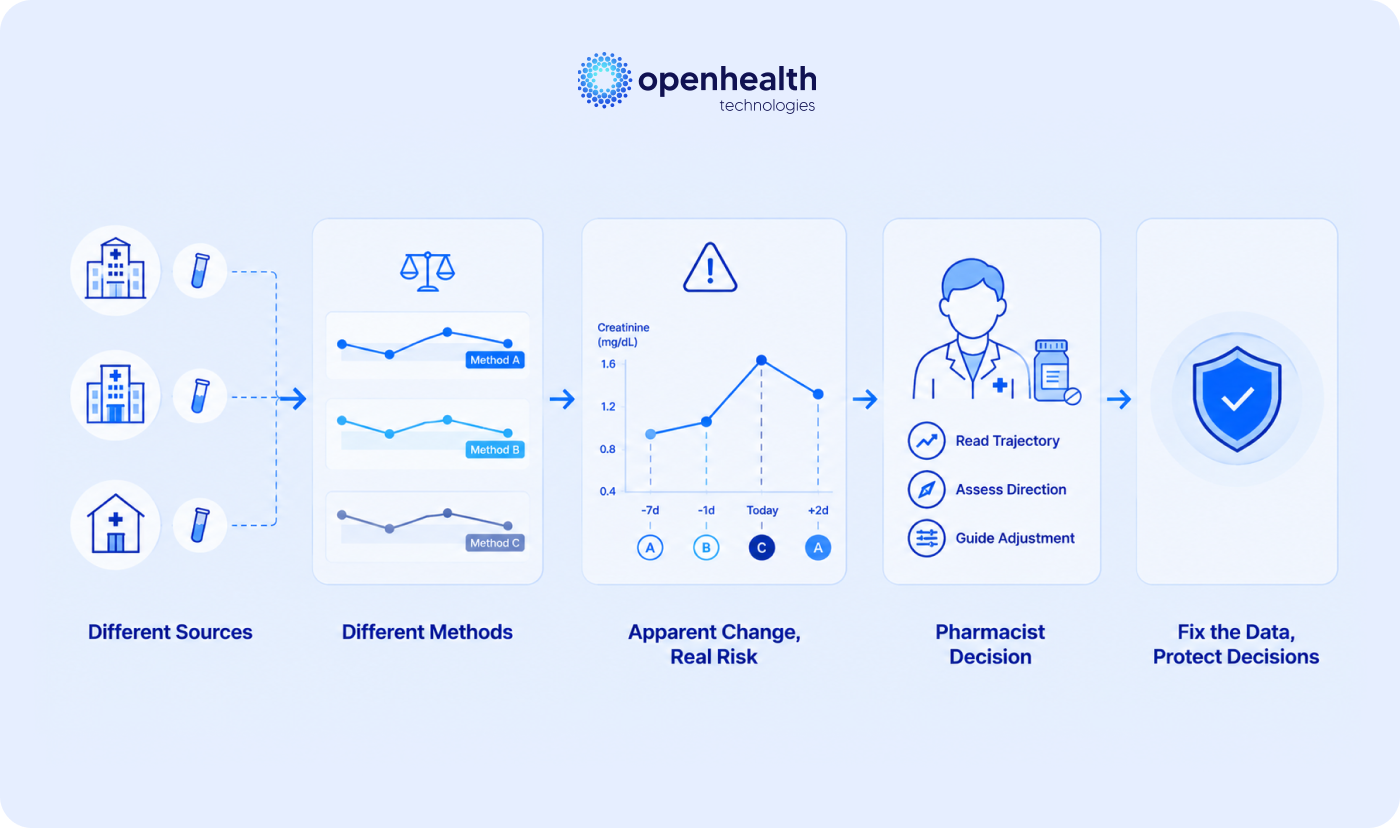
The clinical pharmacist occupies an increasingly central position in hospital patient safety. One of their most critical functions is adjusting the dose of medications whose elimination depends on renal or hepatic function. Antibiotics, anticoagulants, chemotherapy agents, and a long list of drugs need their dose calibrated to the body's capacity to eliminate them, and that capacity is read in laboratory markers: creatinine, estimated glomerular filtration rate, liver enzymes, tracked over time.
Dose adjustment depends, therefore, on reading the trajectory of these markers reliably. And when the markers come from sources with different methods and reference ranges, the clinical pharmacist adjusts doses on a trajectory that may be a laboratory artifact, and not the patient's physiology.
Why dose adjustment depends on the trajectory
Adjusting the dose of a medication with renal elimination isn't a point-in-time decision, it is a decision that follows the patient's evolution. Renal function changes over the course of an admission, whether from the disease itself or the response to treatment, and the dose needs to follow that change. A patient whose glomerular filtration rate is falling needs a different adjustment from one whose renal function is recovering, even if both present, at a given moment, the same value.
This means the clinical pharmacist doesn't read an isolated value, they read a trajectory. Today's creatinine compared with yesterday's and the day before's says whether renal function is stable, worsening, or improving, and that direction is what guides the adjustment. The pharmaceutical decision depends on the comparability of the values over time as much as it depends on the accuracy of each isolated value.
The literature on medication safety emphasizes that the reconciliation and adjustment of therapies depend on precise and comparable clinical information, and that failures in the availability and consistency of that information are among the causes of medication-related errors.¹ Dose adjustment based on organ function markers is a case in which this dependency is direct and the margin for error is narrow.
When the trajectory is artifact, not physiology
The problem arises when the markers that make up the trajectory come from different sources. A patient may have had tests at one laboratory before admission, another test at the hospital laboratory during admission, and have previous values from other providers in their history. If these markers were measured by different methods, with different calibrations and different reference ranges, the trajectory the clinical pharmacist reads may contain variations that don't correspond to any real physiological change.
The literature documents that reference intervals and methodologies vary between laboratories, and that this variation can produce differences in classification and value for the same physiological state.² Applied to dose adjustment, this means an apparent worsening of renal function between two tests may actually be the effect of the two tests having been done by different methods. The clinical pharmacist, reading this trajectory as if it were physiology, may adjust the dose down when it wasn't necessary, underdosing the patient, or fail to adjust when it was necessary, exposing them to toxicity.
Sacks and colleagues, in the recommendations on laboratory analysis in the management of metabolic conditions, reinforce that the comparability of markers over time is essential for management decisions based on their evolution.³ Dose adjustment is precisely a management decision based on evolution, and that is why it is especially vulnerable to methodological variation between the data sources.
The error that doesn't appear as an error
The most dangerous characteristic of this problem is that it doesn't manifest as a visible error. The clinical pharmacist does everything right from a process standpoint: consults the markers, reads the trajectory, applies the adjustment formula, calibrates the dose. Each step is correct. What is compromised is the raw material of the decision, the trajectory of the markers, which carries a variation the pharmacist has no way to distinguish from real physiological variation.
This makes the problem silent and systematic. Silent because the decision looks well grounded, and the eventual bad outcome, an underdose that doesn't control the infection, an overdose that causes toxicity, is attributed to other factors, not to data comparability. Systematic because it affects every adjustment decision that relies on markers from heterogeneous sources, which in practice is most of them, since the hospital patient brings history from multiple providers.
The clinical pharmacist has no way to solve this problem with more care in their own work, because the problem isn't in their work. It is in the data layer that feeds the decision. No degree of diligence in reading the trajectory compensates for the fact that the trajectory mixes physiology with methodological artifact.
The reliable trajectory as the basis of the pharmaceutical decision
The correction goes through ensuring that the markers that make up the trajectory are comparable to each other, regardless of the source that produced them. When each creatinine value, each glomerular filtration rate, each liver enzyme is identified with its methodology, normalized in its unit, and adjusted to its reference range, the trajectory the clinical pharmacist reads comes to reflect real physiology, and not the mix of physiology with laboratory variation. Dose adjustment comes to rely on a reliable base.
This comparability isn't something the clinical pharmacist can produce at the moment of decision, under the pressure of the hospital routine. It needs to be embedded in the data layer that delivers the markers, so that the trajectory arrives at the decision already harmonized. Shortliffe and Cimino reinforce that data quality is the foundation on which any data-assisted clinical decision is built, and that non-harmonized data compromises that decision at the source.⁴ For clinical pharmacy, the foundation is the comparable trajectory of the organ function markers.
This is where OpenHealth Technologies operates. The platform automatically correlates multiple data streams with rigorously validated logical layers of laboratory tests, identifying for each marker its methodology, its unit, and its reference range, and delivering a comparable trajectory over time, mapped to LOINC, across over 3,500 biomarkers. For hospital clinical pharmacy, this means dose adjustment comes to rely on a trajectory that reflects the patient's real physiology, and not the methodological variation between the laboratories that produced the markers.
Learn how your institution can ensure clinical pharmacy adjusts doses on a genuinely comparable marker trajectory, rather than one contaminated by variation between laboratories.