
Laboratory accreditation has stopped being a voluntary differentiator and become, in practice, a commercial requirement. Seals like the PALC from the Brazilian Society of Clinical Pathology and Laboratory Medicine, the ISO 15189 standard, and ONA accreditation are increasingly required for credentialing with insurers, participation in large contracts, and positioning in a competitive market. Laboratories invest significant time and resources to earn these seals, treating them as a quality and marketing objective.
What many discover in the middle of the process is that accreditation is not just an audit of good practices. It is, at its core, a data maturity test. The requirements for traceability, standardization, and comparability that these standards impose frequently run into the fragmentation of the laboratory's own data, and that is where the process stalls.
What accreditation really requires
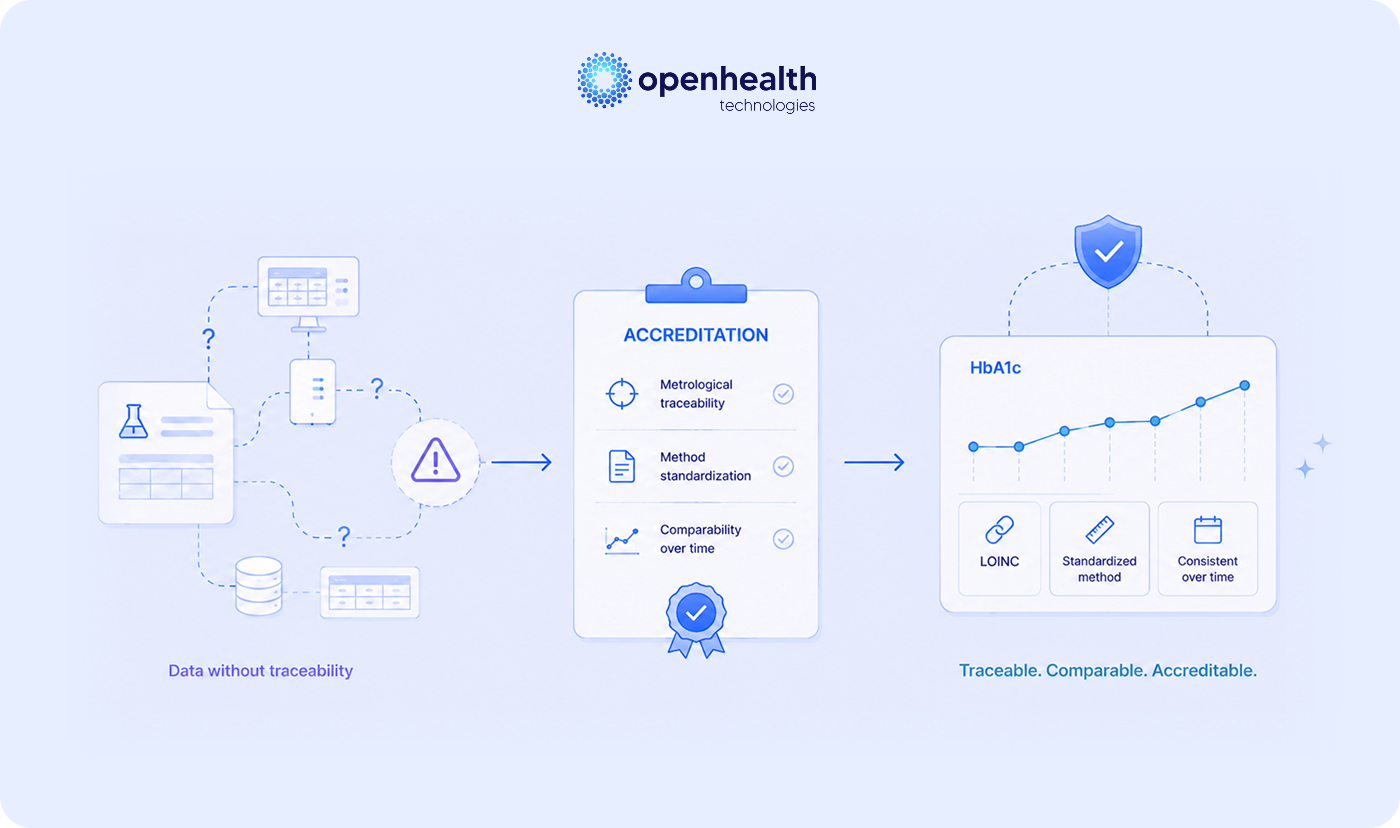
At the center of the main laboratory accreditation standards is a set of requirements that go far beyond the technically correct execution of the test. ISO 15189, the international standard for quality and competence in clinical laboratories, requires metrological traceability of results, documented standardization of methods, and demonstration that results are comparable and reliable over time. It isn't enough for the test to be right today. It is necessary to demonstrate that it is traceable to a reference standard, that the method is documented and controlled, and that the results maintain consistency that allows comparison.
These requirements exist for a sound clinical reason: a result only has value if it can be trusted and compared. Plebani, in his analysis of quality indicators in laboratory medicine, argues that laboratory quality is not measured only by point-in-time analytical accuracy, but by the laboratory's ability to ensure consistency and comparability in a systematic and auditable way. Accreditation, in requiring this, is asking the laboratory to prove not just that it does the test right, but that it generates reliable data in a traceable way.
The problem is that proving traceability and comparability requires the laboratory's data to be organized in a way that many laboratories, in fact, don't have.
Where the process stalls
The point where accreditation frequently meets resistance isn't the bench. It is the data. A laboratory can have excellent analytical quality and still struggle to demonstrate traceability and comparability because its data is dispersed across systems that don't talk to each other, with inconsistent nomenclatures, reference ranges not documented in a structured way, and history fragmented across platforms.
When the auditor asks to trace a result, verify the consistency of a method over time, or demonstrate that results are comparable across different moments or units, the laboratory has to reconstruct that information from sources that weren't organized for that purpose. The work that should be a query becomes a data archaeology, done manually, under audit deadline pressure. The analytical quality is there, but the ability to demonstrate it in a traceable and comparable way, which is what the standard requires, depends on a data organization the laboratory didn't build.
This is especially critical in reference ranges. The literature shows that reference intervals vary between laboratories and methods, and that documenting and tracing those ranges in a structured way is a prerequisite for the comparability accreditation requires. A laboratory that keeps its ranges as loose text in the report footer, without structuring, struggles to demonstrate to the auditor the traceability the standard requires, even if each range is clinically correct.
Accreditation as a data maturity test
Seen from this angle, accreditation reveals its real nature: it is a data maturity test disguised as a quality audit. The standards don't use this language, but what they effectively measure, when they require traceability, standardization, and comparability, is the laboratory's ability to treat its results as structured, traceable, and comparable data, and not just as reports produced correctly and filed.
This distinction has consequences for how the laboratory should prepare. Treating accreditation as a point-in-time documentation effort, concentrated in the weeks before the audit, leads to the data-archaeology-under-pressure pattern that stalls the process. Treating accreditation as a natural consequence of a mature data infrastructure inverts the logic: when the laboratory's data is already structured, traceable, and comparable day to day, demonstrating it to the auditor stops being a project and becomes a query.
There is a benefit that goes beyond the seal. The same data organization that makes accreditation demonstrable, structured data with traceable methodology, unit, and reference range, is the one that makes the laboratory's data usable for everything else: real clinical comparability, integration with providers, feeding analyses, and compliance with regulatory requirements like the REL model of the National Health Data Network. The infrastructure built to pass accreditation is the same one that unlocks the strategic value of the data. Greenberg reinforces that real comparability between results depends on semantic harmonization, and not just formal standardization, which means the data maturity required by accreditation and the one required by strategic use of the data are, at their core, the same.
From the pre-audit sprint to permanent maturity
The change this framing suggests is to stop treating traceability and comparability as something to be produced for the audit, and start treating them as permanent properties of the laboratory's data. When each result is, from the origin, structured and traceable, with its methodology, its unit, and its reference range documented and comparable, accreditation stops being a race against the clock and becomes the confirmation of a maturity that already exists.
That maturity isn't built in the week of the audit. It is built in the data layer that organizes the laboratory's results continuously. And the laboratory that builds it gains two things at once: the accreditation the market requires and the data infrastructure that sustains everything else it wants to do with its results.
This is where OpenHealth Technologies operates. The platform automatically correlates multiple data streams with rigorously validated logical layers of laboratory tests, structuring the laboratory's results with methodology, unit, and reference range identified and mapped to LOINC, in a traceable and comparable way, across over 8,000 biomarkers. For laboratories in the accreditation process, this means the traceability and comparability the standard requires stop depending on a manual reconstruction under audit pressure and become permanent properties of the data, demonstrable at any moment.
Learn how your institution can transform the traceability and comparability required by accreditation into permanent properties of your data, rather than a race against the audit deadline