
In the emergency room, the time between the patient's arrival and the clinical decision is short, and the available information is almost always incomplete. The emergency physician evaluates a patient they often don't know, with an acute complaint, and needs to decide fast. One of the most valuable elements for that decision is also one of the most frequently absent: the patient's baseline, the trajectory of their previous tests, which gives meaning to the value they present now.
Without that baseline, the emergency physician decides on an isolated snapshot, when they would need a film. And the difference between the snapshot and the film, in the urgency, can be the difference between the right conduct and the wrong one.
Why the isolated value isn't enough in the urgency
An isolated laboratory result carries limited meaning without the context of the patient's trajectory. This is a truth of medicine in general, but in the emergency it becomes acute, because it is precisely in the urgency that interpretation needs to be fastest and the error has the most immediate consequence.
Consider a creatinine of 2.0 mg/dL in a patient arriving at the emergency room. In a person whose baseline creatinine was 0.9, this value represents an acute kidney injury requiring immediate investigation and conduct. In a person with established chronic kidney disease, whose creatinine had been living around 1.9, the same value of 2.0 is essentially stable and doesn't indicate an acute event. The number is identical. The clinical meaning is opposite. And what distinguishes the two is exactly the baseline, the information the emergency physician frequently doesn't have.
Without the trajectory, the physician is forced into one of two bad conducts: treating every altered value as acute, which generates unnecessary investigation and intervention in chronically stable patients, or assuming stability and running the risk of underestimating a real acute event. Both conducts are the consequence of the same absence: the baseline that would give meaning to the present value.
The history that exists but doesn't arrive
The most frustrating aspect of this problem is that the patient's baseline frequently exists. The patient arriving at the emergency room with a creatinine of 2.0 has probably had tests before, at some laboratory, in some appointment, at some point. The information that would give context to the acute value was produced. It simply isn't available to the emergency physician at the moment they decide.
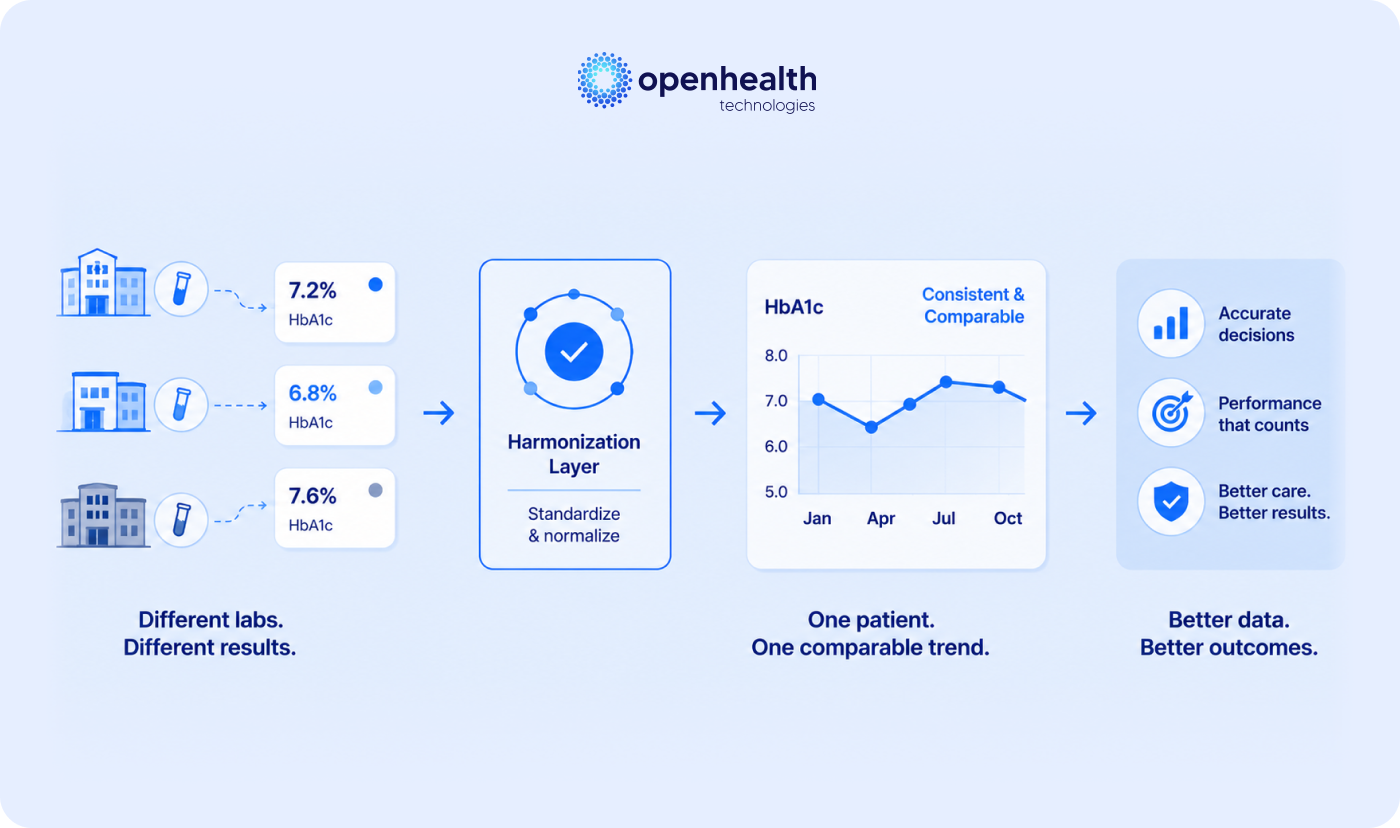
The reason is fragmentation. The patient's laboratory history is spread across different laboratories and systems, in formats that don't talk to each other, at best accessible as a collection of PDFs the patient may or may not have on their phone. Even when some history is available, it arrives in nomenclatures and units different from the current test, which prevents the direct comparison the decision requires. The baseline exists somewhere, but not in a form the emergency physician can use in the minutes they have.
Kripalani and colleagues document that the transfer of clinical information between points of care is frequently incomplete, and that these communication failures compromise the continuity and safety of care.¹ In the emergency, this incompleteness has a particularly acute effect, because the decision is made under time pressure and the cost of deciding without context is immediate.
The highest-risk decision with the least information
There is a perverse inversion in the emergency. It is the environment in which the clinical decision has the highest risk and the smallest margin for error, and it is also the environment in which the available information is most fragmented. The emergency physician decides on potentially serious conditions, with little time, on a patient they don't know, and frequently without the baseline that would give meaning to the values they see. The highest-risk decision is made with the least information.
Shortliffe and Cimino, in a central reference of biomedical informatics, argue that the quality and availability of data at the moment of decision are the foundation of any clinical decision support, and that fragmented or unavailable data compromises the decision at the source.² The emergency is the scenario in which this foundation is most critical and most frequently absent.
The problem isn't solved with more tests in the urgency. Repeating the test in the emergency room gives the physician the current value, but doesn't recover the trajectory. The creatinine of 2.0 measured now remains ambiguous without the history that says whether it rose from 0.9 or was always near 2.0. What the emergency needs isn't more measurement of the present, it is comparable access to the past.
The baseline as data available at the right moment
The correction goes through ensuring that the patient's laboratory history is available, in a structured and comparable way, at the moment and point where the decision is made. When the emergency physician can see, next to the current creatinine of 2.0, the comparable trajectory of the previous values, the ambiguity dissolves. The acute value gains the meaning the baseline provides, and the decision stops being an informed guess to become a grounded reading.
This requires two things: that the patient's history be accessible at the point of care and that it be comparable to the current test. Accessibility depends on integration; comparability depends on harmonization. An accessible but non-harmonized history, in nomenclatures and units different from the current test, still leaves the physician with the work of reconciling data under time pressure, exactly what the emergency doesn't allow. It is the combination of access and comparability that turns the history into a usable baseline.
Plebani reinforces that the value of laboratory data materializes in its incorporation into the clinical decision, and that data that doesn't arrive in a usable form at the moment of decision has its value compromised.³ In the emergency, this incorporation depends on the baseline being not only available, but comparable, at the instant the physician decides.
This is where OpenHealth Technologies operates. The platform automatically correlates multiple data streams with rigorously validated logical layers of laboratory tests, transforming the patient's dispersed laboratory history, from different sources and formats, into a structured and comparable trajectory, mapped to LOINC, across over 3,500 biomarkers. For hospitals and emergency services, this means the physician can see the patient's acute value next to their comparable baseline, and the urgent decision stops being made on an isolated snapshot to be made on the trajectory that gives it meaning.